Sunday, July 7, 2019

History

The sport originated in Victorian England, where it was played among the upper-class as an after-dinner parlour game.It has been suggested that makeshift versions of the game were developed by British military officers in India in around 1860s or 1870s, who brought it back with them. A row of books stood up along the center of the table as a net, two more books served as rackets and were used to continuously hit a golf-ball.
The name "ping-pong" was in wide use before British manufacturer J. Jaques & Son Ltd trademarked it in 1901. The name "ping-pong" then came to describe the game played using the rather expensive Jaques's equipment, with other manufacturers calling it table tennis. A similar situation arose in the United States, where Jaques sold the rights to the "ping-pong" name to Parker Brothers. Parker Brothers then enforced its trademark for the term in the 1920s making the various associations change their names to "table tennis" instead of the more common, but trademarked, term.
The next major innovation was by James W. Gibb, a British enthusiast of table tennis, who discovered novelty celluloid balls on a trip to the US in 1901 and found them to be ideal for the game. This was followed by E.C. Goode who, in 1901, invented the modern version of the racket by fixing a sheet of pimpled, or stippled, rubber to the wooden blade.
In 1921, the Table Tennis Association was founded, and in 1926 renamed the English Table Tennis Association. The International Table Tennis Federation (ITTF) followed in 1926. London hosted the first official World Championships in 1926. In 1933, the United States Table Tennis Association, now called USA Table Tennis, was formed.
In the 1950s, paddles that used a rubber sheet combined with an underlying sponge layer changed the game dramatically, introducing greater spin and speed. These were introduced to Britain by sports goods manufacturer S.W. Hancock Ltd. The use of speed glue increased the spin and speed even further, resulting in changes to the equipment to "slow the game down". Table tennis was introduced as an Olympic sport at the Olympics in 1988.
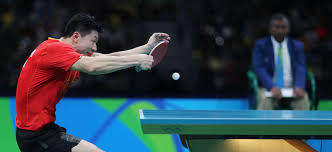
                                          Image result for ma long pic playing tt

Equipment

Racket/paddle

Players are equipped with a laminated wooden racket covered with rubber on one or two sides depending on the grip of the player. The wooden portion of the racket, often referred to as the "blade", commonly features anywhere between one and seven plies of wood, though cork, glass fiber, carbon fiber, aluminum fiber, and Kevlar are sometimes used.Common wood types include balsalimba, and cypress or "hinoki", which is popular in Japan. 
                                                 Image result for table tennis rackets

Ball

In professional sports you would be hard-pressed to find a more perfectly consistent piece of equipment. Each ball must weigh 2.7 grams (between 2.67 and 2.77 grams), have a diameter of 40 millimeters (between 40.0 and 40.6), and when dropped from 30 centimeters the ball must bounce back to 240 mm (240-265 mm).. Modern balls are made from plastic (the sport has moved away from celluloid as a material in international competitions due to safety concerns associated with raw celluloid manufacture).
                                                     Image result for table tennis balls images

Table

While surface thickness is still the most important part of the table, making sure your table can withstand the weather is key when considering an outdoor table. That’s why these tables are manufactured with a material that specifically combats glare and warping, and are designed to be weather resistant.
                                            Image result for table tennis tables

Grips

Though table tennis players grip their rackets in various ways, their grips can be classified into two major families of styles, penhold and shakehand.

Penhold


Penhold is the Asian-style grip of holding the racket, where the head of the racket is facing down and is held the way a person holds a pen or pencil.The style of play among penhold players can vary greatly from player to player. The most popular style, usually referred to as the Chinese penhold style, involves curling the middle, ring, and fourth finger on the back of the blade with the three fingers always touching one another.
                                                            Image result for penhold grip

Shakehand

The shakehand grip is so-named because the racket is grasped as if one is performing a handshake.Though it is sometimes referred to as the "tennis" or "Western" grip, it bears no relation to the Western tennis grip, which was popularized on the West Coast of the United States in which the racket is rotated 90°, and played with the wrist turned so that on impact the knuckles face the target. In table tennis, "Western" refers to Western nations, for this is the grip that players native to Europe and the Americas have almost exclusively employed.The shakehand grip's simplicity and versatility, coupled with the acceptance among top-level Chinese trainers that the European style of play should be emulated and trained against, has established it as a common grip even in China.
                                                            Image result for shakehand grip image in table tennis

Seemiller

The Seemiller grip is named after the American table tennis champion Danny Seemiller, who used it. It is achieved by placing the thumb and index finger on either side of the bottom of the racquet head and holding the handle with the rest of the fingers. Since only one side of the racquet is used to hit the ball, two contrasting rubber types can be applied to the blade, offering the advantage of "twiddling" the racket to fool the opponent.
                                                          Image result for seemiller grip images

Friday, July 5, 2019

Types of strokes

Table tennis strokes generally break down into offensive and defensive categories.

Offensive strokes

Hit

A direct hit on the ball propelling it forward back to the opponent. This stroke differs from speed drives in other racket sports like tennis because the racket is primarily perpendicularto the direction of the stroke and most of the energy applied to the ball results in speed rather than spin, creating a shot that does not arc much, but is fast enough that it can be difficult to return. 

Counter-hit

The counter-hit is usually a counterattack against drives, normally high loop drives. The racket is held closed and near to the ball, which is hit with a short movement "off the bounce" (immediately after hitting the table) so that the ball travels faster to the other side. A well-timed, accurate counter-drive can be as effective as a smash.

Smash

The offensive trump card is the smash. A player will typically execute a smash when his or her opponent has returned a ball that bounces too high or too close to the net.  The goal of a smash is to get the ball to move so quickly that the opponent simply cannot return it. Because the ball speed is the main aim of this shot, often the spin on the ball is something other than topspin. Sidespin can be used effectively with a smash to alter the ball's trajectory significantly, although most intermediate players will smash the ball with little or no spin. An offensive table tennis player will think of a rally as a build-up to a winning smash.

Defensive strokes

Push

The push is usually used for keeping the point alive and creating offensive opportunities. A push resembles a tennis slice: the racket cuts underneath the ball, imparting backspin and causing the ball to float slowly to the other side of the table. While not obvious, a push can be difficult to attack because the backspin on the ball causes it to drop toward the table upon striking the opponent's racket.  Often, the best option for beginners is to simply push the ball back again, resulting in pushing rallies. Against good players, it may be the worst option because the opponent will counter with a loop, putting the first player in a defensive position. 

Chop

A chop is the defensive, backspin counterpart to the offensive loop drive. A chop is essentially a bigger, heavier push, taken well back from the table.  The object of a defensive chop is to match the topspin of the opponent's shot with backspin. A good chop will float nearly horizontally back to the table, in some cases having so much backspin that the ball actually rises. Such a chop can be extremely difficult to return due to its enormous amount of backspin. Some defensive players can also impart no-spin or sidespin variations of the chop.

Block

The block is a simple shot, but nonetheless can be devastating against an attacking opponent. A block is executed by simply placing the racket in front of the ball right after the ball bounces; thus, the ball rebounds back toward the opponent with nearly as much energy as it came in with. This requires precision, since the ball's spin, speed, and location all influence the correct angle of a block.  Depending on the spin of the ball, the block may be returned to an unexpected side of the table. This may come to your advantage, as the opponent may not expect this.

Effects of spin

Adding spin onto the ball causes major changes in table tennis gameplay. Although nearly every stroke or serve creates some kind of spin, understanding the individual types of spin allows players to defend against and use different spins effectively

Backspin

Backspin is where the bottom half of the ball is rotating away from the player, and is imparted by striking the base of the ball with a downward movement. At the professional level, backspin is usually used defensively in order to keep the ball low.Backspin is commonly employed in service because it is harder to produce an offensive return, though at the professional level most people serve sidespin with either backspin or topspin.  It is actually possible to smash with backspin offensively, but only on high balls that are close to the net.
                                                      

Topspin

The topspin stroke has a smaller influence on the first part of the ball-curve.  Like the backspin stroke, however, the axis of spin remains roughly perpendicular to the trajectory of the ball thus allowing for the Magnus effect to dictate the subsequent curvature. After the apex of the curve, the ball dips downwards as it approaches the opposing side, before bouncing.On the bounce, the topspin will accelerate the ball, much in the same way that a wheel which is already spinning would accelerate upon making contact with the ground. The speed limitation of the topspin stroke is minor compared to the backspin stroke. Topspin is the least common type of spin to be found in service at the professional level, simply because it is much easier to attack a top-spin ball that is not moving at high speed.
                                                       

Sidespin

This type of spin is predominantly employed during service, wherein the contact angle of the racket can be more easily varied. Unlike the two aforementioned techniques, sidespin causes the ball to spin on an axis which is vertical, rather than horizontal.The axis of rotation is still roughly perpendicular to the trajectory of the ball. In this circumstance, the Magnus effect will still dictate the curvature of the ball to some degree. Another difference is that unlike backspin and topspin, sidespin will have relatively very little effect on the bounce of the ball, much in the same way that a spinning top would not travel left or right if its axis of rotation were exactly vertical. This makes sidespin a useful weapon in service, because it is less easily recognized when bouncing, and the ball "loses" less spin on the bounce

Thursday, July 4, 2019

The Beautiful Game: Tennis Turns Sport Into Art

A thing of beauty is a joy for ever. How appropriate, then, that tennis has been giving pleasure to the world for centuries.
But what makes something as abstract as tennis such a thing of beauty? What are the splendid strands of color that, when intertwined, produce the rich and complex embroidery of what, after all, is just a sport?
The strongest and brightest threads, the essential fabric of the tapestry, are the athletes who ply their trade in the tennis limelight: the players themselves.
Ever since the cultural flowering of classical Greece, the beauty of the human form in action has been celebrated. Statues chiseled to muscular perfection more than two millennia ago mirror today’s flesh and blood bodies, honed to the same perfection in the pursuit of peak fitness.
For admirers of the human form, tennis holds one particular advantage. The complexity of the skills and attributes required to perform at this sport’s highest level allows players of many shapes, builds, and styles to flourish. Which means that, for the fans, there is something for everyone.
For every woman who admires the muscular biceps of Rafael Nadal, there is another who favors the angled shoulders of Roger Federer, or the lean frame of Novak Djokovic.
For every man who is drawn to the statuesque Maria Sharapova, another is drawn to the elegance of Ana Ivanovic, or the rangy Elena Dementieva.
Some prefer an in-your-face personality: Serena Williams, Robin Soderling, or Fernando Gonzalez. Others like their players serene and respectful: Bjorn Borg, Venus Williams, or James Blake.
But the appeal of tennis is far more than skin deep. It combines many finer strands from many art forms that, woven together, make it a uniquely strong, complex, and beautiful sport.
At the heart of great drama is individual conflict or quest, and the most compelling drama uses plot and character to advance an emotional or physical journey.
So imagine the tennis court as the setting for a play or a film, and watch the players take to their stage for an opening performance.
The dramatis personae have to maintain concentration, focus, energy, and tactics in the face of constant challenge. They have to win the last point, regardless of the number of games, or sets, or hours that have passed. They have to repeat their all-out effort in every match, at every tournament.

History

The sport originated in Victorian England, where it was played among the upper-class as an after-dinner  parlour game . It has been suggest...